The future of electric vehicles: 3 predictions for 2023
You don’t need to be clairvoyant to predict that more electric vehicles (EVs) will hit the road in 2023. It’s official: EV adoption has accelerated rapidly, and is now mainstream. In the UK, battery electric vehicles (BEVs) made up around 17% of new cars registered in 2022, making them more popular than diesel engines. And that trend doesn’t show any sign of slowing; EVs are forecast to have a 67% adoption rate across Europe by 2030. Thanks to significant investment, innovation, and regulatory support, EV owners have ceased to be seen as outliers. Instead, they’re merely early adopters of what will soon become ubiquitous technology.
Sustaining that growth is less straightforward, however. Though EVs are becoming more popular with consumers, they’re still in their relative infancy. As consumer demand and market competition increase, EVs will need to evolve – and fast. So what’s next? Here’s what we expect to happen in 2023.
EVs leverage data to add new use cases
Competition in the EV market is hotting up. Though Tesla still dominates, nearly every legacy car manufacturer has now launched an electric model to catch up. They’re joined by an influx of startup challengers in the fight for customers’ attention (and wallets).
The winners will be those that can create the best customer experience – and that means adding new use cases to EV apps that increase functionality, convenience and cost savings. Ultimately, there’s still an experience gap for EV owners. There are obvious infrastructure issues, like the patchiness of charge point coverage. But there are other problems too, which are much lower-hanging fruit to solve. Today, the apps consumers use to manage their vehicles don’t often do much besides surface data like model details, location, and sometimes state of charge (SoC). Failing to enable them to action that information is missing a trick, and limiting the amount of value they can get from their EVs.
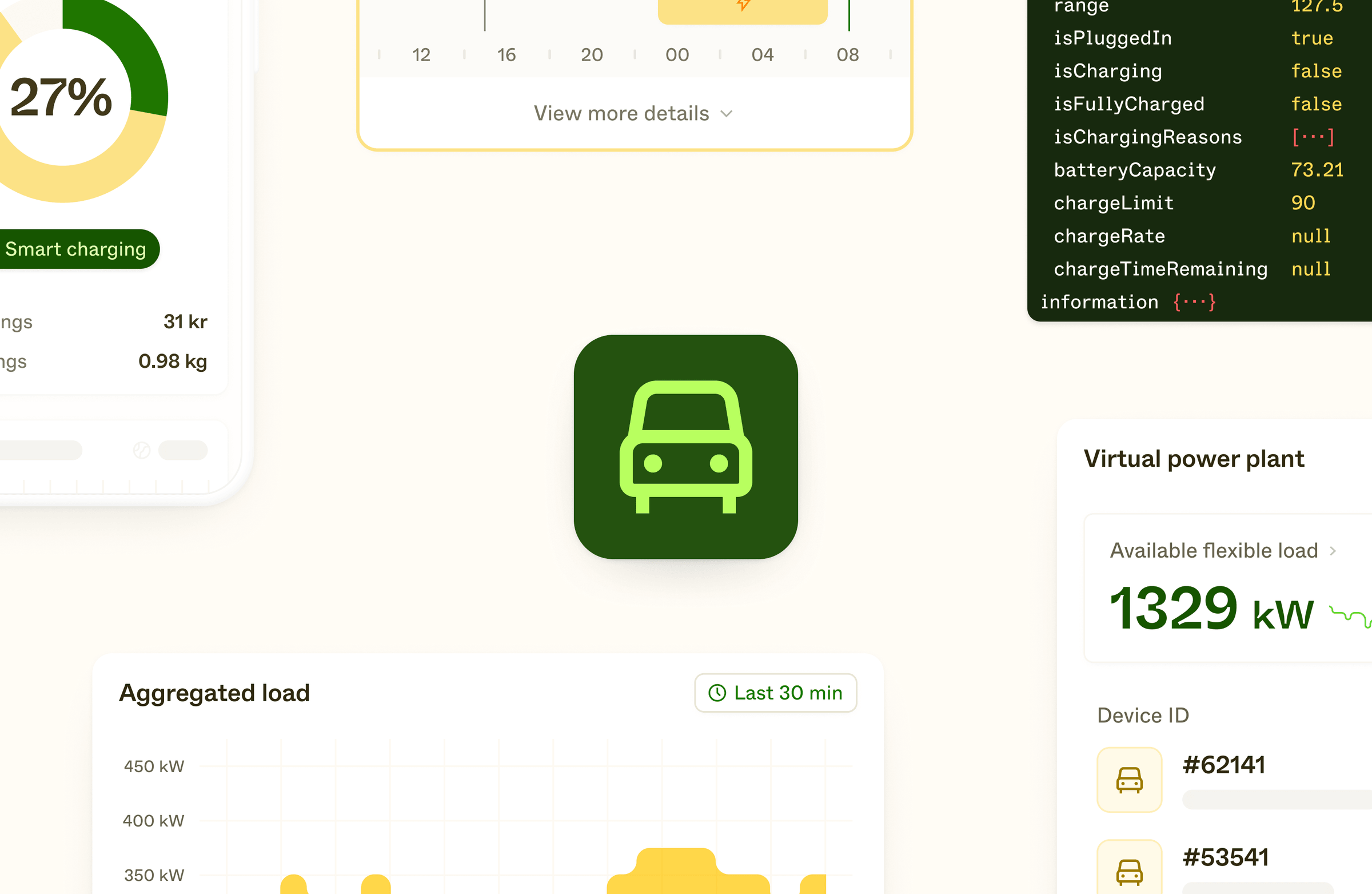
As we get closer to the promise of the software-defined vehicle, we expect to see lots of new functionality added to EV apps to increase their value for consumers. 4G connected vehicles contain a massive amount of data that can be displayed and leveraged. Take SoC data. It can power a range of new use cases like trips and charging statistics, fleet management and e-mobility. But the first we expect to see become table stakes is smart charging. With smart charging, drivers can set a time when their EV should be fully charged the next day (e.g. 7am). Then, their EV app can automatically trigger the car to start charging when prices are lower when renewable energy is available. It saves them money and helps them reduce their carbon footprint. This is something that every EV owner will soon expect by default.
EVs accelerate the transition to renewable energy
Electrification of transportation could eliminate up to 16% of today’s emissions – but only if we can power EVs with renewable energy.
Today, that’s not possible. Or at least - not consistently, and not at scale. Solar and wind power is, by nature, intermittent. That presents a challenge, as we need to consume electricity simultaneously as it is being produced. One solution would be to build more capacity into the grid. But that would be an enormous infrastructure project. Rystad Energy estimates that it would be necessary to install solar and wind capacity that produces at least 150% of the energy needed throughout a year to power Germany by renewable energy alone. And even then, there would still be times when demand outstripped supply. In many countries, much larger over-capacity would be needed, especially as more and more consumers switch to EVs.
The other solution is to use EVs more flexibly – like in the smart charging example above. One of the good things about EVs is that they’re idle and plugged in for most of the day. Because they don’t need to consume energy all the time, they’re well-positioned to respond to fluctuations in production. Doing so could have significant impacts, since 30% of household electricity consumption comes from EV charging.
Alongside smart charging, we can also expect EVs to be used as Virtual Power Plants (VPPs). EV batteries can be used to capture renewable energy when it’s abundant and store it for use in times of deficit, helping stabilize the grid in a world of intermittent supply. Creating that demand-side flexibility means we can continue accelerating our transition to renewable energy, even as millions more EVs connect to the grid.