Ostrom connects tens of thousands of devices across a growing energy ecosystem

Connected, flexible energy systems depend on interoperability between retailers, hardware manufacturers, and the partners that orchestrate them. Each plays a role in making these products work.
Ostrom brings these pieces together at scale through its dynamic tariff and NeoGrid VPP, connecting devices directly into the core energy product.
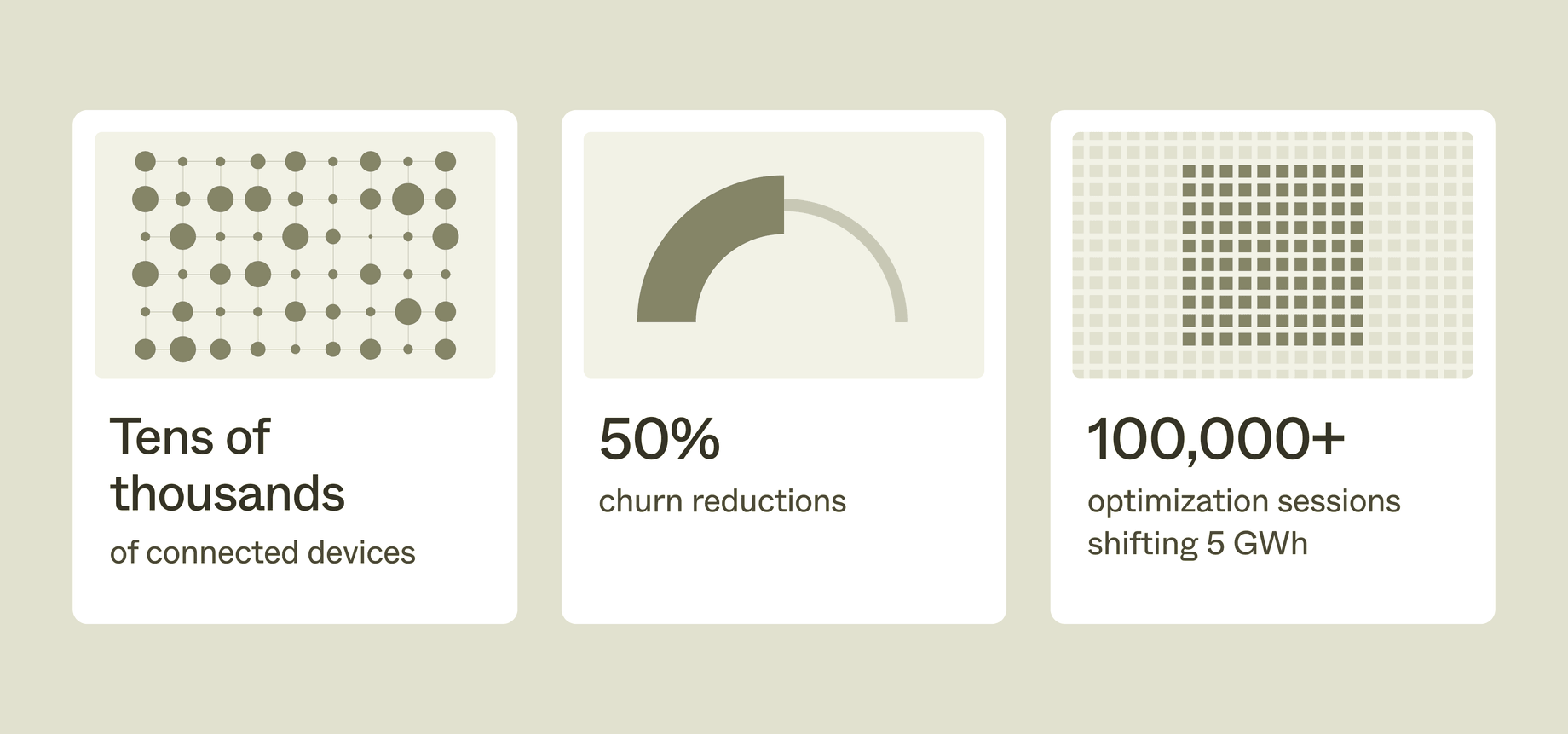
Over the past year, the company has nearly doubled its connected device base to tens of thousands of electrical vehicle (EV) chargers, batteries, and solar systems. Battery connections alone have grown by around 200 percent year over year. As Ostrom expands its connected offering, partners like go-e are seeing equally impressive growth, with their devices reaching more engaged customers through the ecosystem.
The results show what becomes possible when retailers and OEMs operate through a shared ecosystem. Built on Enode’s infrastructure, this model allows all parties to take part in best-in-class connectivity, a non-negotiable if you want assets to participate in flex use-cases.
Building one of Germany’s largest residential VPPs
Ostrom moved quickly from early traction to meaningful volume.
The company passed 10,000 connected devices early and continues to grow rapidly. To date, Ostrom has shifted over 5 GWh of energy to more efficient times of use, across more than 100,000 sessions. This allows customers to benefit from lower prices while supporting better use of available renewable energy.
This level of activity requires more than device access. By building on Enode’s infrastructure, Ostrom operates its portfolio without managing individual integrations, while maintaining consistent device behavior across OEMs. This includes reliable data, control, and the ability to coordinate how devices respond to pricing and optimization logic, as well as how these capabilities are exposed to customers inside the product.
Consumer value drives adoption
Households that connect their EV charger, battery, or solar system benefit from automatic optimization. Charging shifts to lower-priced hours. Batteries respond to price signals. The system works in the background, optimizing based on user preferences such as charging targets or schedules, while allowing customers to adjust or override when needed.
Connected EV users save up to 50 percent per year. Customers eligible for NeoGrid AI and other programs can earn an additional €300 annually per device category.
“We didn’t want connectivity to be something customers had to think about. It should work in the background, deliver consistent savings, and make the product more valuable over time. That’s what drives long-term engagement.”
As more customers experience that value, adoption continues to accelerate.
Lower churn and higher engagement
Connected customers behave differently. They engage more with the product, expand their setup with additional devices, and are significantly less likely to churn, with churn reductions of up to 50 percent.
Customer value increases through savings and automation. Retail value improves through retention and engagement. System value grows as more assets are connected, optimized and participate in flexibility programs.
“Once devices are connected, the relationship changes. We are helping customers operate their assets more efficiently. Enode makes that scalable without increasing complexity.”
OEMs are a crucial part of the value creation
OEMs play a central role in making these propositions work. Devices that integrate well into energy products enable better outcomes. Energy management, for example EV charging, works as expected. Optimization delivers savings. The experience is reliable. This requires hardware that is easy and secure to connect to energy management software, with accurate and complete data and quick and reliable commands.
The home EV chargers from go-e meet all of these criteria, and it is visible in the growth in number of connected devices. Over the past year, connected go-e chargers in Ostrom’s ecosystem have grown by approximately 200 percent. This is a result of go-e´s strategy of openness, enabling energy retailers like Ostrom to integrate with their chargers, giving EV owners the flexibility to choose their preferred energy retailer for smart EV charging.
“Energy retailers like Ostrom help customers unlock more value of their hardware. When devices are integrated into the energy tariff and the wider home energy system, the value becomes more visible to the customer. Integrating through Enode allows us to support these use cases without building retailer integrations one by one.”
Ostrom has introduced a co-branded dynamic tariff model, allowing OEMs to launch co-branded offers and receive a commission for referred customers. Installation partners can be included as well. This connects hardware adoption directly to energy usage and long-term customer relationships.
A model that continues to compound value
What started as a dynamic tariff has become a connected energy ecosystem.
Ostrom continues to grow its customer base as more households adopt EVs, batteries, and solar systems. Customers are seeing real savings. OEM partners are gaining access to an engaged retail channel.
Retailers that operate connected devices will build stronger customer relationships. OEMs that integrate into these ecosystems will reach more active users. Customers will increasingly expect their energy provider to do more than supply electricity.
Enode provides the infrastructure that enables this model. Retailers, like Ostrom, use that infrastructure to build a product that delivers value across the ecosystem.