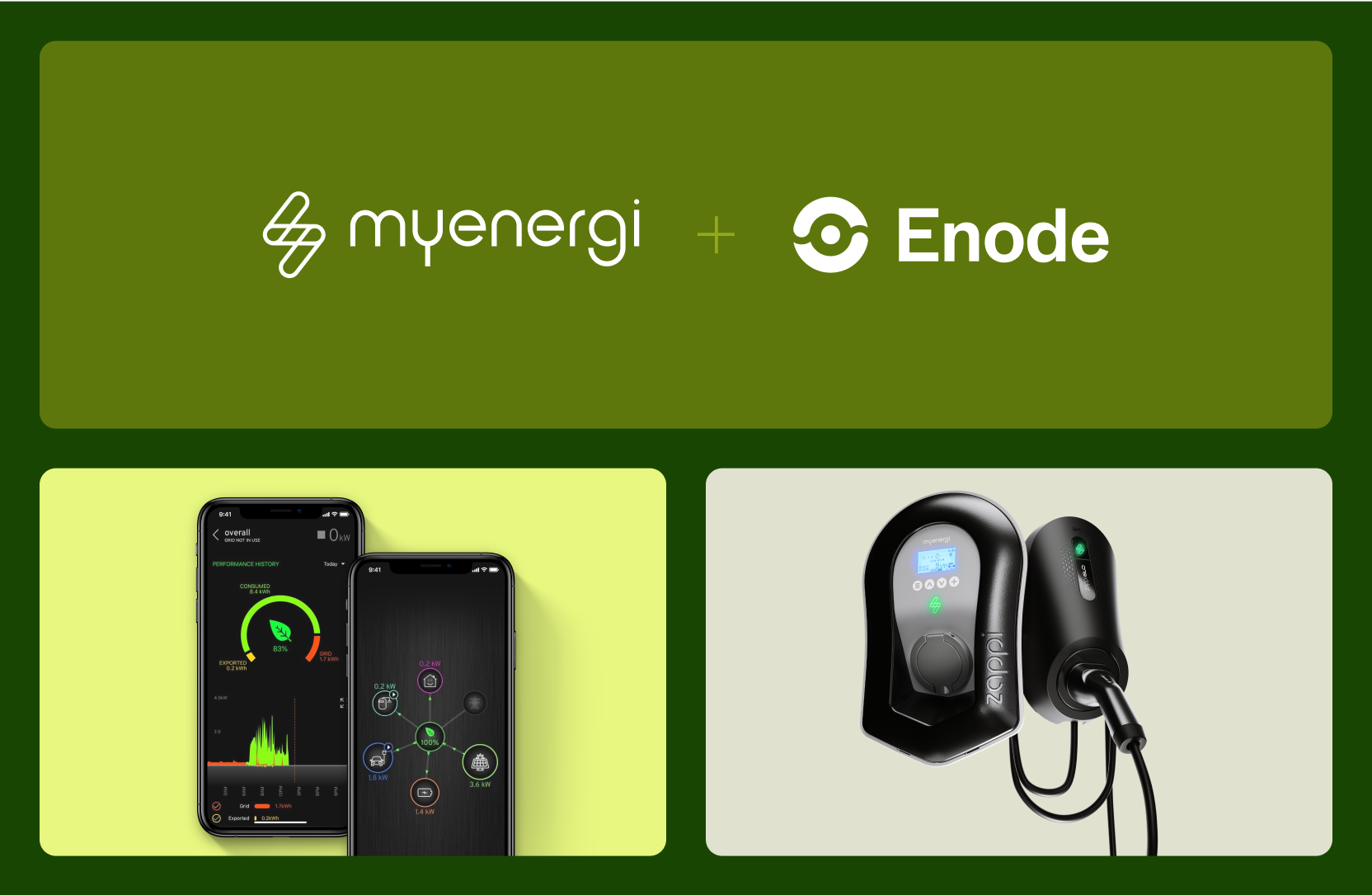
myenergi x Enode: How EV charging is shifting from hardware to flexibility
Over the past decade, electric mobility has gone from niche to mainstream. Millions of drivers have made the switch to electric, supported by an expanding network of home chargers that make charging simple and convenient. But as adoption accelerates, something new is happening. The focus is shifting from access to intelligence.
What began as a hardware challenge, building enough chargers, fast enough, has become a software opportunity. The question is no longer only how we charge, but also when and why. Charging is moving from a static, individual experience to a connected, system-level one.
At the heart of this shift sits the home charger. Once a passive appliance, it’s now one of the most important touchpoints between consumers and the grid. By deciding when and how to charge, every household can influence both their own energy costs and the stability of the wider system.
We spoke with our partner, myenergi, about how the EV charging industry has evolved, and how collaboration with Enode is shaping what comes next.
From hardware to flexibility
The story of EV charging mirrors the story of electrification itself: it began with access, matured with intelligence, and is now entering an era of flexibility.
In the early years of the transition, progress was measured in hardware. The challenge was availability, installing chargers fast enough to keep pace with growing EV adoption. Charging was simple by design: plug in, charge and unplug. For most drivers, it worked well enough. The focus was on getting infrastructure in place, not on optimizing how it was used.
As adoption grew and electricity prices fluctuated, the focus began to shift. The second wave of innovation was about smart charging, making the experience cheaper and greener. Instead of charging as soon as the cable was connected, smart chargers started to react to time-based or price-based signals. A charger could automatically start when electricity was at its lowest cost or when renewable generation was highest.
This was the moment charging became part of the energy conversation. For the first time, users could actively engage with the grid without changing their behavior, for example by setting their charger to automatically start when electricity was cheapest or when renewable generation peaked. But while it worked well for individuals, it didn’t yet work for the system as a whole. When thousands of EVs started charging at the same time, often around midnight, the result was simply a new kind of peak. Smart, but not yet sustainable.
Today, the industry is entering a new phase: flexibility. Charging is no longer just a household optimization; it’s becoming a grid service. Chargers and vehicles are now capable of communicating with energy retailers, flexibility platforms and even local grid operators. Instead of reacting in isolation, they can coordinate charging across thousands of homes, helping balance the grid, integrate renewables and reduce strain on infrastructure.
Few companies illustrate this evolution better than myenergi. Their ecosystem of devices; zappi, eddi, and libbi, gives households the means to generate, store, and use renewable energy intelligently.
“We’ve always believed the future of energy is connected,” says Jack Fielder, Chief Commercial Officer at myenergi. “For us, that means helping people consume and produce energy in smarter ways and making sure our products can work seamlessly with the systems around them.”
This is the shift that myenergi and Enode are enabling together. myenergi’s hardware ecosystem gives households the means to generate, store, and use renewable energy intelligently. Enode provides the digital layer that connects those devices to the energy system around them.
Together, we’re turning everyday chargers into flexible assets, ones that can make energy use cleaner, cheaper, and more resilient at scale.
Making flexibility effortless
Residential energy flexibility can only scale if it feels effortless. Most households don’t want to think about energy markets, demand response, or grid balancing; they just want charging that works, saves money, and uses cleaner power whenever possible.
The real opportunity now lies in making that sophistication invisible. Behind every simple charging experience are complex systems that predict prices, balance supply and demand, and manage millions of connected devices. The challenge is to make that intelligence work quietly in the background, so users only notice the benefits.
myenergi’s approach is built around that principle. When connected through Enode, zappi chargers adapt to any household setup, regardless of tariff type or technical knowledge. For drivers on dynamic tariffs, charging automatically shifts to the cheapest or cleanest hours of the day. For those on fixed tariffs, optimization still happens, just in a way that maintains predictable costs and stable routines.
The result is flexibility that’s invisible but meaningful. Users continue to charge as usual, but their choices support a cleaner and more balanced grid.
“Real flexibility depends on collaboration,” says Mathilde Kverneland, Senior Partnerships Manager at Enode. “When hardware, software, and energy companies work together, households get a better experience and the grid becomes more resilient.”
By embedding this intelligence directly into the devices people already use, myenergi and Enode are showing that advanced energy services don’t have to be complicated. They can be seamless, automatic, and beneficial for everyone, from individual households to the wider grid.
Building an open energy ecosystem
The energy transition is too complex for any single company to solve. Unlocking flexibility at scale depends on collaboration between hardware manufacturers, energy retailers, and the digital platforms that connect them. Each plays a role: devices gather data and respond to signals, retailers design propositions that reach consumers, and platforms like Enode make it possible for connected assets and energy systems to work as one.
This open approach is built into myenergi’s DNA. From the beginning, their devices have been designed to integrate, not isolate. A zappi charger or libbi battery isn’t locked into one ecosystem or app, it’s built to work with others. That mindset has helped myenergi grow into one of Europe’s most connected home-energy brands, trusted by users who want technology that adapts as their needs evolve.
Through Enode, myenergi’s ecosystem becomes part of a broader, data-driven flexibility network that links homes, retailers, and the grid. Enode’s connectivity layer allows myenergi devices to link directly with utilities, flexibility aggregators, and energy retailers across Europe. This connection enables new propositions, like smart tariffs, coordinated home-energy management, and participation in virtual power plants, to reach consumers faster and more efficiently.
For manufacturers, this marks a defining shift. Connectivity is no longer a feature; it’s a prerequisite for relevance. The best products will be those that integrate seamlessly, give customers access to new services, and strengthen the resilience of the grid.
myenergi and Enode share the same view: collaboration multiplies the value. Together, they’re proving that open ecosystems can deliver better outcomes for users, partners, and the planet alike.
The road ahead
The next chapter of electrification is already taking shape. As EVs, chargers, and home-energy systems become more connected, the lines between consumption, storage, and generation are disappearing. Every device that can shift, store, or share electricity will soon play an active role in the energy system.
Bidirectional charging will accelerate that shift. As the technology matures, EVs will move beyond being flexible consumers to become mobile energy assets—powering homes, storing excess solar, and helping stabilize the grid when demand is high. Achieving that vision depends on the foundations being built today: open standards, secure connectivity, and collaboration between hardware manufacturers, energy companies, and technology platforms.
myenergi and Enode are building those foundations together, turning everyday devices into flexible, interoperable assets that make the grid smarter and more resilient. The future of energy isn’t about more devices; it’s about better connections and the intelligence behind them.